THE EVICTION FILE: FROM THE FIRST ORDER TO TODAY
Updated: Jul 27
This is not a single event. It is a file — one that has been building, piece by piece, for nine months. Read it in order, and judge for yourself whether what happened today was ever really about a lease.
OCTOBER 28, 2025 — THE ORDER
Parishioners had just done something canonically ordinary: they appealed to the Holy Assembly of Bishops. Days later, Bishop Irinej ordered Fr. Dragoslav's removal — not for anything Fr. Dragoslav had done, but as punishment aimed at the people who dared to appeal. There was no accusation against him. No named complaint. No “needs of the diocese” that anyone could point to and explain. There was only timing: parishioners spoke up, and their priest paid for it.
The shock of it sent him to the emergency room the next day. He has been on protected medical leave ever since — nine months, as of today.
A bishop who cared for the well-being of his clergy would have noticed that. This one did not. He has shown, again and again, that his priests are not people to be cared for — they are instruments to be used against the parishioners who cross him.
JANUARY 9, 2026 — THE APPEAL
This was not the only letter parishioners had sent to Belgrade. Some were met with silence — no reply at all. Others received only a generic form response: a polite acknowledgment, nothing more. This letter was different. This is the one that got an actual, substantive answer — a written confirmation that the matter would genuinely be taken up.
Parishioners filed this canonical appeal with the Holy Synod — the formal beginning of a process that, by law of the Church itself, was supposed to determine whether any of this was even valid.
JANUARY 23, 2026 — BELGRADE CONFIRMS
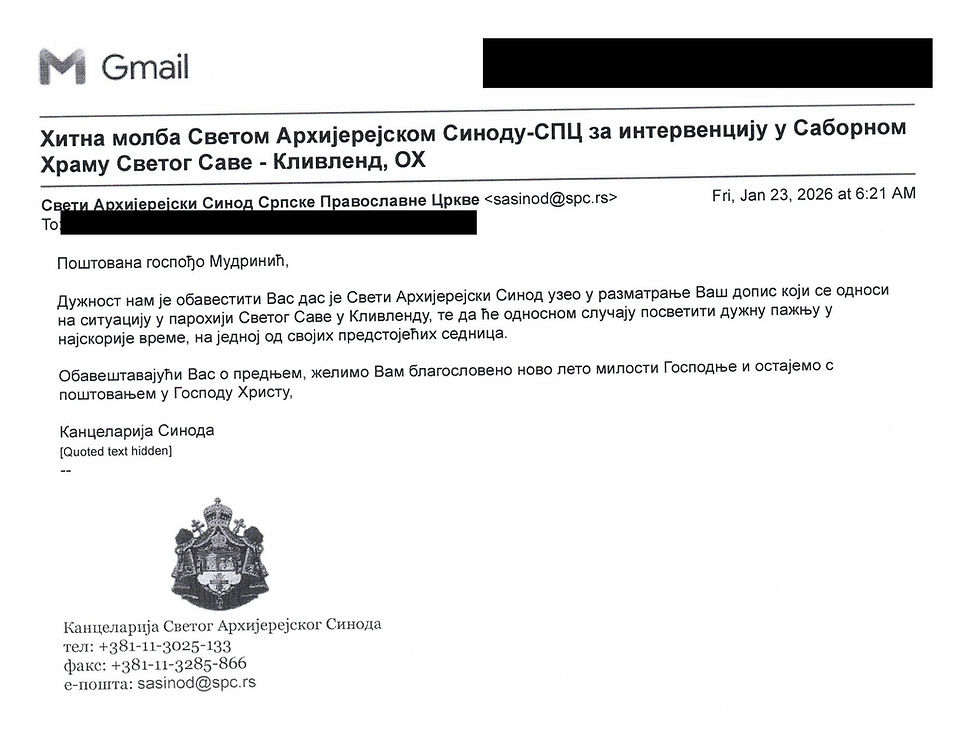
Two weeks after the appeal was filed, the Office of the Holy Synod wrote back, confirming the appeal had been received and would be addressed “at one of its upcoming sessions.” That confirmation still stands. The appeal, as of today, has not been decided.
MARCH 31, 2026 — DON'T GET A LAWYER
Among the exhibits filed with the court today is a letter the Bishop's office sent Fr. Dragoslav back in March. Its subject line: “Legal Representation.” Its message: if he retained an attorney, he would be in violation of Canon Law — Article 36. A man who has not received his salary in eight months, whose health had collapsed, and who was about to lose his home, was warned, in writing, months before any of this reached a courtroom, that defending himself was itself the offense.
It is now part of the public court record.

ON OR ABOUT APRIL 15, 2026 — THE LIE ABOUT THE SALARY
Fr. Dragan Vuković — brought in from Johnstown, PA — told Dean Milan Pajić that Fr. Dragoslav's salary had been paid in full: “We honored everything.” It hadn't been. Eight months without pay is not a rounding error. It is a fact with a bank record attached.
MAY 25, 2026 — THREE DAYS TO LEAVE
Fr. Dragoslav and Protinica Rosanda received a Notice to Leave Premises — three days to vacate the parish house at 6306 Broadview Road. The stated reason: “termination of tenancy... the tenant is no longer employed as a priest.” The notice bore no signature. No name. Just “Board of Trustees.”

JUNE 18, 2026 — WRONG COURT
The Trusteeship's first eviction case (2026-CVG-010091) was heard in Cleveland Municipal Court, Housing Division.
JUNE 22, 2026 — DISMISSED
Judge Cheryl M. Wiltshire dismissed the case without prejudice. The property's mailing address says “Cleveland” — the court's jurisdiction does not. Even the eviction itself couldn't be filed the first time correctly.


JUNE 24, 2026 — TRY AGAIN, IN PARMA
Six days later, a new complaint was filed — this time in the correct venue, Parma Municipal Court (Case 26CVG03349). Attorney William Peseski of Weston Hurd LLP signed it on the Trusteeship's behalf. Service was completed via bailiff on July 2.
JULY 20, 2026
The courtroom filled with parishioners standing beside their priest. Representing the Trusteeship: Second Vice President Nick Visha, Treasurer Zora Lytkowski, and their attorney. Representing Fr. Dragoslav: Fr. Dragoslav — alone, pro se, on medical leave, with dignity.
He asked the court to stay the proceedings until the Holy Synod rules on our ecclesiastical appeal — the same appeal Belgrade confirmed in writing five months ago. He submitted the Bishop's own letter warning him against legal representation as evidence of the pressure surrounding this case, and the parishioners' petition — signed by over 120 people — as proof the appeal is real, pending, and unresolved.
The magistrate denied the stay and proceeded with the hearing.
HOW DID HE GET THOSE MINUTES?
Here is a question worth sitting with.
In open court, the Trusteeship's attorney acknowledged possessing the internal minutes from the Holy Assembly of Bishops — a meeting held in Belgrade, in May, closed to the public, closed to the press, closed to ordinary parishioners who have been waiting months just to learn whether their own appeal was even read.
Ask yourself: how does an eviction lawyer in Parma, Ohio, end up holding the minutes of a private ecclesiastical session held across the ocean?
He didn't request them. Church councils don't take FOIA requests. He didn't stumble onto them. These are not documents that leak out on their own.
The Serbian Orthodox Church's own Constitution treats these records as exactly that — internal and guarded. Article 39 requires officials and secretaries of Church bodies to swear an oath to “keep official secrets.” Church practice going back decades holds that the acts and minutes of Assembly sessions are to be kept in the archive of the Holy Synod, and nowhere else.
These are not casual documents. They are records the Church's own rules say belong locked away, entrusted only to those sworn to guard them — not pulled out of a filing cabinet at a civil law firm in Cleveland to help evict a sick priest from his home.
Someone took a sealed record of the Church's own governance and handed it to a lawyer suing a priest.
And there is only one person in this entire story who was actually in that room in Belgrade: Bishop Irinej himself.
So we ask, plainly: if the Bishop has no involvement in this eviction — if this is truly, as we've been told, a matter between the Trusteeship and one difficult priest — then why did internal Church deliberations from a closed session in Belgrade end up in the hands of the Trusteeship's own eviction attorney?
Either the Bishop handed them over himself, or someone in his direct office did, on his authority. There is no third option.
And even setting that question aside — even if the Bishop has every right in the world to order this eviction — a separate question remains, untouched by any of that: does a Bishop have the authority to hand internal Holy Assembly deliberations to a private civil attorney, for use in a secular eviction proceeding? Authority over a priest's assignment is not the same as authority over the confidentiality of a closed session involving every bishop in the Assembly, not just this Diocese.
A man sworn — by the very Constitution he governs under — to guard the Church's secrets used one of them as a weapon against his own priest.
ONE RULE FOR THE PRIEST. ANOTHER FOR THE BISHOP.
Sit with these two facts side by side.
On March 31, the Bishop's office warned Fr. Dragoslav, in writing, that retaining a lawyer to defend himself would itself be a violation of Canon Law — grounds for a Church trial.
By July 20, the Bishop's own office — or the Bishop himself — had handed a civil attorney internal minutes from a closed session of the Holy Assembly of Bishops, so that lawyer could use them against Fr. Dragoslav in an eviction proceeding.
A sick priest was told that hiring a lawyer to protect himself was a canonical crime. Meanwhile, the Bishop was arming the lawyer suing him.
One man was forbidden from seeking legal help. The other was quietly supplying the opposing counsel with material no outside attorney should have ever possessed. This is not hypocrisy in the abstract, forgivable-human-weakness sense. This is a man weaponizing Church law against the weaker party while breaking that same Church's confidentiality rules to strengthen the stronger one.
Canon law for the man with no lawyer. Cooperation for the man with the lawyer. That is not shepherding. That is not justice. That is a rigged fight, dressed in vestments.
Nine months. One order in October. Many canonical appeals since January. One warning against hiring a lawyer in March. One lie about a paycheck in April. One eviction notice with no name on it. One dismissed case. One refiled case. And, today, one priest, standing alone, asking only that the Church be allowed to finish judging its own before the state finishes evicting him.
August 17 will tell us what happens next.
Perhaps it's time the Holy Synod took a closer look at who they've entrusted with this Diocese — though none of this surprises us. We do not wish to remain under a bishop we no longer trust: not with our money, and not with our loyalty. A man who cannot account for millions in missing funds, who undermined his own fellow bishops to a foreign government, and who — by his own documented past — helped sell out Kosovo to American officials while wearing the robes of the Serbian Orthodox Church, has earned neither.
There is only one word for someone who works against his own people, his own brothers, and his own homeland. Traitor.





You morons quote Wikileaks but obviously never read it. It says Irinej is the one who helped Serbia to try and keep Kosovo. What utter nonsense. Stay off the coke!