The Identity Crisis Deepens
- Special Correspodent
- Feb 3
- 5 min read

Bishop Irinej's Ecumenical Enthusiasm and the Slow Erosion of Serbian Orthodox Integrity in the Eastern American Diocese
A year ago, this publication warned that the Eastern American Diocese under Bishop Irinej Dobrijevic was sliding into an identity crisis. We pointed to the unprecedented reading of a pastoral encyclical by Archbishop Elpidophoros during the Divine Liturgy on Orthodoxy Sunday, the growing influence of the Assembly of Canonical Orthodox Bishops of the United States (ACOB), financial non-transparency, and procedural irregularities. We asked whether the Diocese was quietly veering away from its canonical Serbian Orthodox roots toward a pan-American, inter-jurisdictional model more suited to Constantinople than to Belgrade.
Unfortunately, the past twelve months have brought neither correction nor clarification. On the contrary, they have brought escalation. The most visible and most troubling development has been Bishop Irinej's ever-deepening involvement in ecumenical activities that many faithful Orthodox consider incompatible with the holy canons and with the self-understanding of the One, Holy, Catholic, and Apostolic Church.
Two events from 2025 particularly illustrate this troubling trend: the reading of a foreign jurisdictional letter on Orthodoxy Sunday and attendance at a Roman Catholic installation Mass.
March 9, 2025 – Orthodoxy Sunday: Reading an Encyclical from a Foreign Jurisdiction
In a move that sent shockwaves through Orthodox communities across America, parishioners of the Eastern American Diocese were confronted on Orthodoxy Sunday—a feast dedicated to affirming Orthodox doctrinal unity and traditional jurisdictional boundaries—with the reading of a pastoral encyclical signed by Archbishop Elpidophoros, primate of the Greek Orthodox Archdiocese of America, on behalf of the Assembly of Canonical Orthodox Bishops.

The deep irony of choosing this particular day to introduce the practice of inter-jurisdictionalism was not lost on the faithful. Orthodoxy Sunday—when Orthodox Christians commemorate the victory over iconoclasm, anathematize heresies, and confess the purity of the Faith—becomes the day when Serbian parishes read a letter from a Greek archbishop?
This development begins with the decision of the Assembly's Executive Committee on June 4, 2024 to designate Orthodoxy Sunday as "Assembly of Bishops Sunday" and to "issue annually a Pan-Orthodox encyclical for all Orthodox parishes in the country." The Eastern American Diocese's own website published this decision with no visible consultation with the Holy Hierarchical Synod in Belgrade.
On March 9, 2025, on Orthodoxy Sunday, clergy of the Eastern American Diocese read an encyclical signed by Archbishop Elpidophoros that called upon the faithful to "support our sincere efforts for Orthodox Christian unity through sustained and generous gifts of your time, talent, and treasure"—directly soliciting financial support for the Assembly.
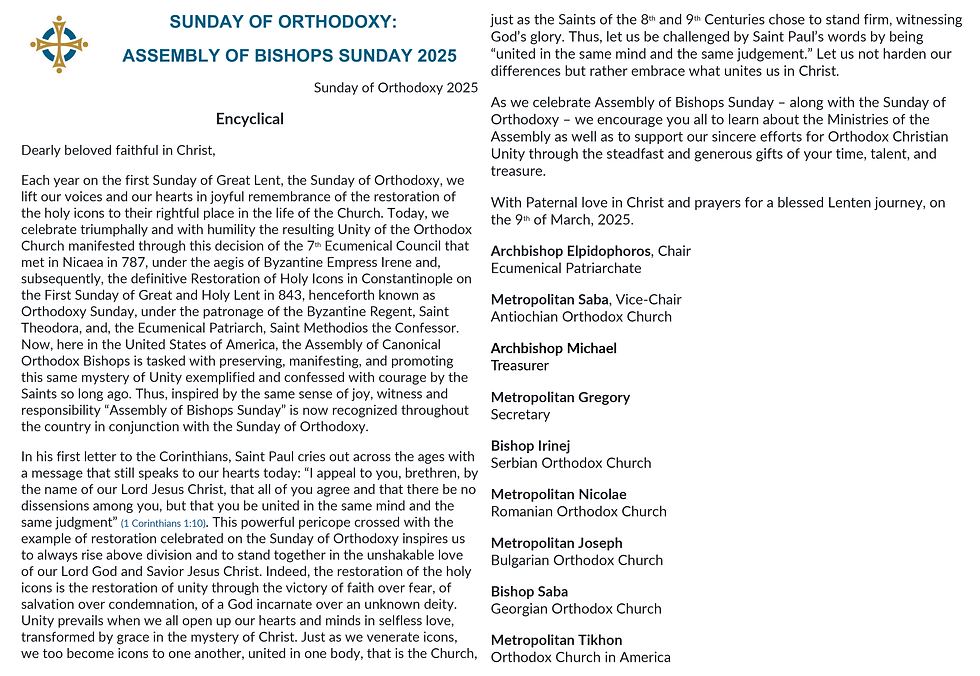
The questions are numerous and serious:
• Why does a diocese belonging to the Serbian Orthodox Church read directives from the Greek Archdiocese on Orthodoxy Sunday?
• Has the Assembly become a higher authority than the Mother Church in Belgrade?
This precedent—that Serbian parishes read a letter signed by a Greek archbishop—represents a dramatic shift in jurisdictional relationships. When a Serbian bishop allows an encyclical composed by a Greek archbishop to be read in his parishes on the most important dogmatic feast of the year, the signal is clear: the Assembly is no longer merely a coordinating body—it is becoming a supra-jurisdictional structure with direct access to the faithful.
March 11, 2025 – The Installation Mass of Cardinal Robert McElroy
Yet another shocking example occurred on March 11, 2025 at the Basilica of the National Shrine of the Immaculate Conception in Washington, D.C., at the installation Mass of the new Roman Catholic Cardinal Robert McElroy as Archbishop of Washington. Just two days after Orthodoxy Sunday (March 9, 2025), when Orthodox Christians commemorate the victory over iconoclasm and confess the purity of the Faith, Bishop Irinej attended an entire Roman Catholic Mass.

Photographs and video from the Basilica show Orthodox hierarchs, including Bishop Irinej, seated in the front rows, present for the reading of the Latin Creed (with the Filioque), the Our Father, the consecration, and the entire rite—including the kiss of peace.
This is not mere presence—this is active participation in a Roman Catholic liturgy that contains dogmatic additions the Orthodox Church has condemned for centuries. Apostolic Canons 45 and 46 clearly forbid even prayer with heretics, much less presence and participation in their liturgy. This event occurred immediately after Orthodoxy Sunday, on which heresies are anathematized—including those related to the Filioque and papal primacy. Such behavior represents a direct insult to the Fathers and the holy canons.
A Pattern, Not an Isolated Incident
This is not a one-time incident. Bishop Irinej has appeared at similar occasions before. In January 2024, he was photographed at a reception following a prayer service for the Week of Prayer for Christian Unity organized by the Armenian Church, standing alongside Cardinal Dolan, Bishop James Massa, and representatives of the Lutheran, Syriac, and Coptic traditions. The pattern is consistent: joint prayer services, receptions, public appearances with heterodox clergy, all presented as "witness" or "dialogue."

The irony is particularly striking when one considers what Bishop Irinej himself wrote in 2019 in his paper "Ecumenical Dialogue from the Perspective of Orthodox Churches in Oceania" (published in the journal Historia magistra vitae est): "Common prayer with those who do not share the fullness of the faith can be dangerous if it is understood as recognition of the equality of churches" and "Ecumenism must not be a path toward creating some 'super-church,' but toward a return to the fullness of truth." And today this same bishop participates in joint prayer services and attends Roman Catholic Masses—violating his own words from 2019 and the apostolic canons he previously cited as a standard. This is not merely disagreement with the canons—this is hypocrisy that deeply offends the faithful and undermines the credibility of pastoral ministry.
Critics are not opposed to polite conversation or cooperation on moral issues (e.g., defense of the unborn, aid to persecuted Christians). But when that cooperation crosses into joint liturgical or prayer contexts, it enters territory the canons forbid and which is dangerous to the integrity of the Faith. The faithful rightly ask: Why does our bishop constantly place himself in such situations? And why does the Diocese remain silent when objections are raised?
Canonical and Identity Questions
The deeper problem is of a jurisdictional and ecclesiological nature. ACOB, in which Bishop Irinej is active, increasingly functions as a coordinating body that issues joint statements, organizes joint events, and—most troublingly—expects its directives to be read in parishes of all jurisdictions. When a Serbian bishop reads an encyclical composed by a Greek archbishop on Orthodox Sunday, the signal is clear: the Assembly is becoming a higher authority than the Mother Church in Belgrade.
Add to this the financial and administrative controversies that have been simmering since 2024 (unexplained timber revenues, tax debts on properties such as Marča Monastery, questionable parish board decisions) and the picture is one of a diocese increasingly alienated from Serbian tradition and accountability. Ecumenism is not the only symptom, but it is the most visible and, for many faithful, the most painful.
A Call for Explanation
The Eastern American Diocese belongs to the Serbian Orthodox Church. Its bishops are primarily accountable to the Holy Hierarchical Synod in Belgrade, not to pan-Orthodox assemblies or ecumenical committees in New York. The faithful have the right to know whether Bishop Irinej's ecumenical engagement represents a personal orientation that deviates from the mind of the Church.
Until clear answers are given, the questions remain:
• Does the Diocese affirm that common prayer with heterodox clergy is permitted by the holy canons?
• Will the Diocese publicly distance itself from events that blur the boundaries between Orthodoxy and other confessions?
• Or will the identity crisis continue, slowly transforming Serbian parishes into something unrecognizable to their spiritual forebears?
The faithful await an answer. Silence, in this case, speaks volumes.
St. Sava Parish News will continue to monitor these developments and faithfully report to the people of God.
Comments and correspondence are welcome at parohijanisvsava@gmail.com


Comments